Sacred Spaces in Outdoor School
Best practices in ECE
How kinship is formed with land and why it’s an important part of outdoor education
When I think about sacred spaces, I think about places that hold a spiritual purpose or where religious ceremonies or rituals take place, but in the context of outdoors school and for many outdoor educators it’s a place that we visit again and again and have a relationship with. It’s a place that evokes feelings of belonging, freedom and calmness. The more frequently we visit a place the more we want to care for and grow to respect it.
At Mountain School teachers have names for places too like “monster rock” or “bunny hill” I even named some places in my neighborhood as “bee hill” and “raccoon trail.” “The process of labeling a place is to establish the relationships we have with our surroundings. To give it a name is to give it respect and recognition: it is the beginning of love. Love and respect are authentically developed over time, after repeated experiences.” (Campbell, Thompson 2013) Campbell’s students named a fallen tree at her outdoor school “troll bridge.”
The Hopi Indians think places that bring forth life are sacred like a spring that is upstream bringing water to everything below, it is seen as the blood flowing through Mother earth. And the Ohlone concept of sacred land had to do with where their ancestors once roamed. What is common here is that the place holds special meaning for people not because of how it’s used but how we feel about it. If we feel joined to a place and have meaningful experiences there our love for it will naturally spring forth without effort. It is adults who bring children these spaces and allow them ample time to play and investigate their surroundings, growing to know it intimately.
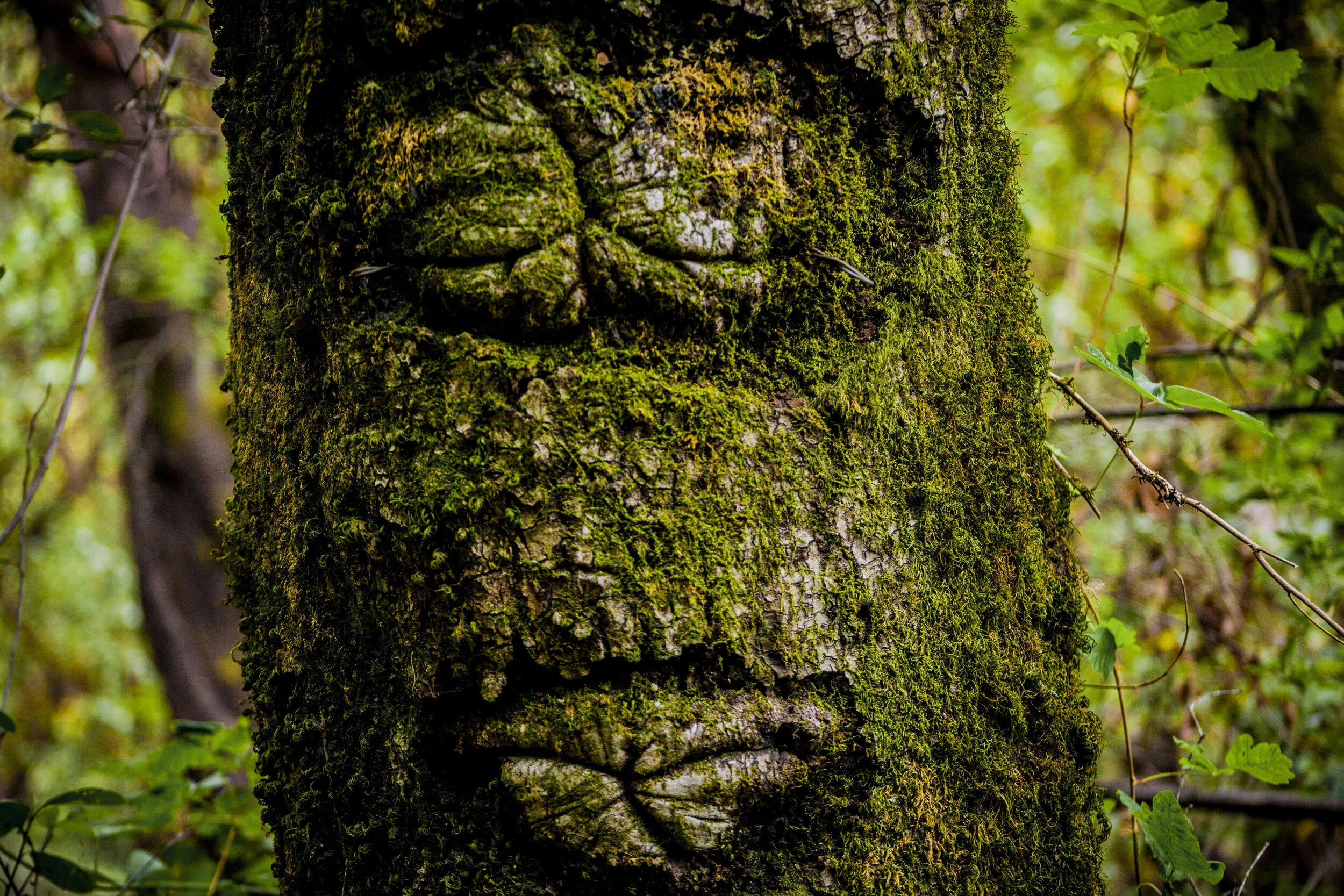
Woyake teacher researcher Renatta Goeson, states, “growing up among the trees, I have deep respect for them not only because symbolically view a tree’s roots as my ancestors, the beginning of our story of who we are as a family. I am but one branch of this tree.” Like the first people to inhabit the land nature lovers feel a kinship with nature too. The more time we spend in nature-contemplating it’s vastness the more we begin to respect it.
But down deep, at the molecular heart of life, we’re essentially identical to trees.
Carl Sagan
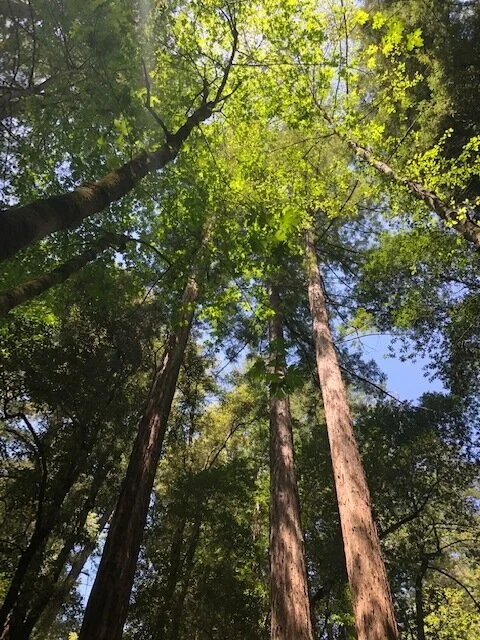
Ancient Redwood trees at Sanborn
Sanborn Creek is a place that I hold sacred because of my familiarity with it, the history of the land and the memories we made there as a community. I have taken my classes and my friends there hundred of times over the years and our entire school community has a relationship with it. Over the years the landscape will change due to weather and things like fallen tress but none the less it remains a constant, stable majestic place for me and my former students. It’s a place where the Ohlone tribe once lived and prepared food. There are grinding holes there where acorns were processed into tortillas and baskets were weaved.
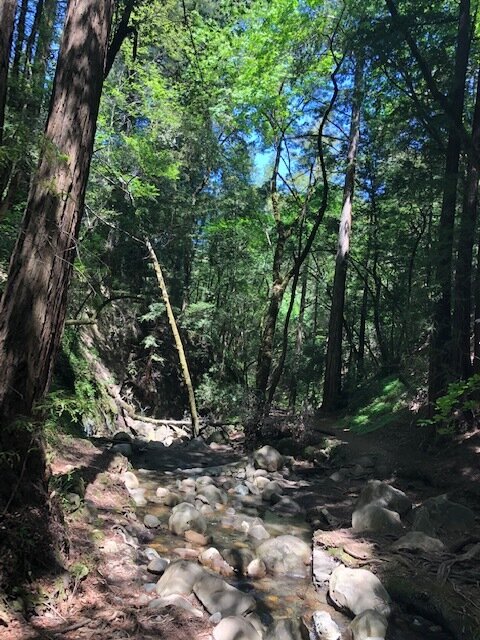
Creek bed that leads to the Ohlone grinding holes
“Those who contemplate the beauty of the earth find reserves of strength that will endure as long as life lasts. There is something infinitely healing in the repeated refrains of nature -- the assurance that dawn comes after night, and spring after winter.”-Rachel Carson
Contemplation and respectful practices
During COVID-19 school closure parents of my former students and I became very reflective and started exchanging stories and memories of this place that felt really sacred to us, a place their children loved and asked to return to over and over. A place where special Mountain School memories took place. During this time of social distancing parents were having gratitude for Sanborn Creek, at the base of the Santa Cruz mountains. During shelter in place Sanborn became a place of family renewal and escape from the emanate pressures of the day. Many of the parents said they felt their time there was “timeless” and they were filled with gratitude for having been introduced to this place.
When we went there as a school the teachers tried to share Ohlone stories in an attempt to preserve some of the history of the first people and tell the children about how they used the land. Each teacher had a different approach but the same intentions to keep the memory of these people alive in the minds of future generations. We always made sure to point out the grinding holes to children and we give them rocks and seeds so they can try grinding too. Parents and children would be full of questions that lead them to do more research about the people who once lived there and where are they now? The parents all expressed feelings of appreciation for this retreat tucked away from the busyness of the road and cars. What they love about it is that it is open and unclaimed by modern intrusions. The space is natural and their children play for hours on end in this “untamed” area.
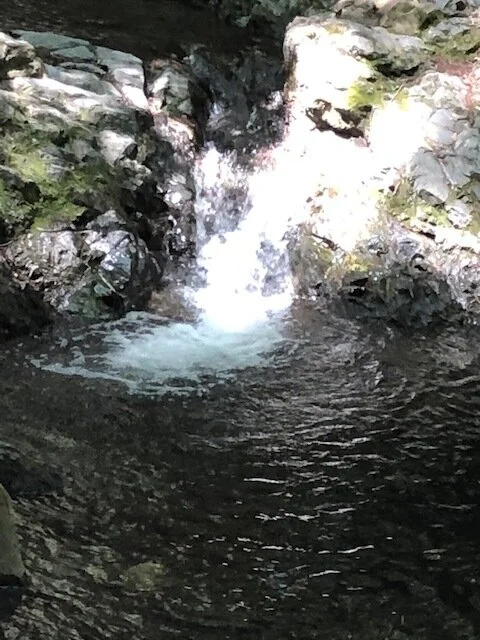
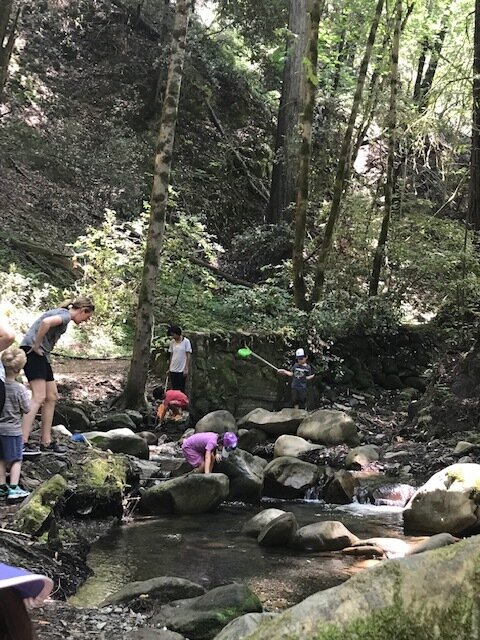
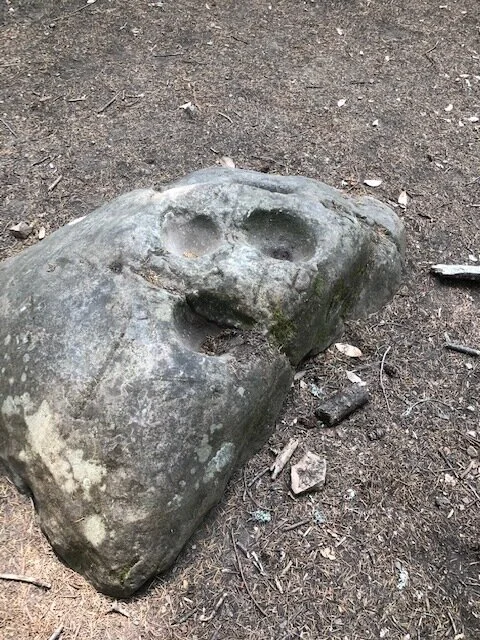
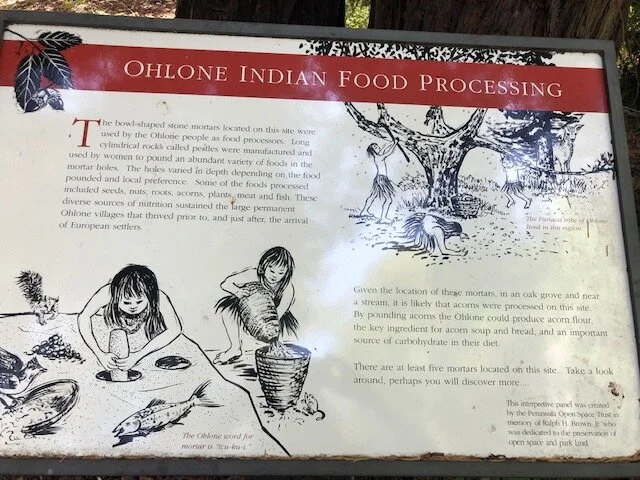
Sanborn is so beautiful and natural looking but it also evokes feelings of clam and awe! When I lived in the south bay it was one of the places I went to meditate and find solace when things became overwhelming.
Another outdoor school practice that models respect is to “leave no trace” which is one of the seven principles establish by the Center for Outdoor Ethics. Many schools refrain from taking things or picking flowers and taking things away from the land. We also “leave it better than you found it.” By carrying trash bags everywhere we go in nature we role model picking up litter even if we didn’t leave it there. I’ve never had a child protest helping in this way. They understand that we preserve and don’t desecrate with graffiti and trash.
References:
Banyacya, Thomas, director. Hopi Messenger-Thomas Banyacya (1909-1999). 0:08 / 11:52 Hopi Messenger - Thomas Banyacya, Sr. (1909-1999), Sacred Land Film Project, 12 Sept. 2017, www.youtube.com/watch?v=3igP8udqfaw
Bologna, C. (2018, September 28). Travel Experts Explain Why People Return To The Same Places Again And Again. Retrieved May 22, 2020, from https://www.huffpost.com/entry/return-to-same-vacation-spot_n_5a539f53e4b01e1a4b181060
Campbell, D., & Thompson, S. (2013). Naturally Speaking. In D. R. Meier & S. Sisk-Hilton (Authors)Nature education with young children. integrating inquiry and practice. (pp. 105-123) New York: Routledge.
Momaday, N. S. (1998). Revisiting Sacred Ground. The man made of words: Essays, stories, passages. New York: Griffin.
Leave No Trace Center for Outdoor Ethics https://lnt.org/why/7-principles/
Sayer, Anne Marie. How This Native American Elder Reclaimed Sacred Land in the Bay Area KQED News, YouTube, 20 Nov. 2019, www.youtube.com/watch?v=qYgZ1Pxw6aI&t=14s.